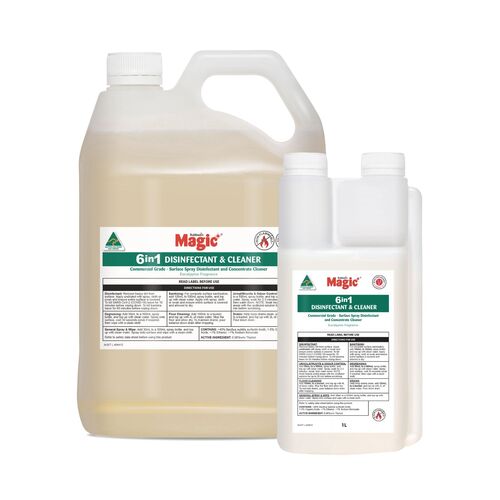
Product Description
Many businesses have a different product for each cleaning process which adds to the complexity of inventory control and staff training. Some of these chemicals are harmful, and poisonous and require you to wear extensive PPE.
Our Commercial Grade Disinfectant Cleaner 6in1 effectively breaks down dirt, F.O.G. (fats, oils, grease), struvite, and germ cells so they can be washed away. Rather than using poisonous chemicals or chlorine and bleach to kill germs. This one-of-a-kind product breaks tradition by uniquely combining our naturally derived Surfactin with other bio-surfactants[2] and Thymol[3], a natural disinfectant. Making it a powerful, environmentally friendly, cleaner, disinfectant, and degreaser, requiring minimal PPE.
Ideal for:
- Kitchens and BBQs
- Rangehoods and Gas or Electric Cooktops
- Sinks and Splashbacks
- Bathrooms, Showers
- Toilets, Urinals
- Flooring; Timber, Polished Concrete, Linoleum, Tiles, and Grout
Handy Hint: To help maintain clear drains pour the balance of the floor cleaning solution down the drain or urinal.
For a crystal clear finish on glass use PuraChoice Glass Cleaner or Magic Glass Cleaner and Protector
How to Use
|
APPLICATION
|
DILUTION mL / Litre
|
|
Disinfecting
|
Use Undiluted
|
|
Struvite Removal
|
100mL / 1 Litre
|
|
Degreasing
|
100mL / 1 Litre
|
|
Drains
|
50mL / 1 Litre
|
|
Floors
|
25mL / 1 Litre
|
|
General Spray & Wipe
|
60mL / 1 Litre
|
HOW TO USE
Degreasing: Add 50mL into a 500mL spray bottle, and top up with clean water. Spray onto the surface, wait 30 seconds scrub if required, and then wipe with a clean cloth.
Urinal/Struvite & Odour Control: Add 50mL to a 500mL spray bottle, and top up with clean water. Spray, soak for 1-2 minutes, scrub then wash down. Note: Use undiluted for heavy build-ups.
Disinfectant: Remove heavy dirt from the surface. Apply undiluted with a cloth or swab. Ensure the entire surface is covered. Leave for 10min before wiping down.
Drains: Add 100mL to a bucket, and top up with 2L of clean water. Pour down the drain.
Floor Cleaning: Add 100mL to a bucket, and top up with 4L of clean water. Apply to the floor using a mop and leave to dry.
General Spray & Wipe: Add 30mL to a 500mL spray bottle, and top up with clean water. Spray onto the surface and wipe with a clean cloth.
Note: Heavily soiled areas may need repeat treatments.
The Science
- Surfactin: https://www.sciencedirect.com/science/article/pii/S0927776521001934
Highlights
- a. High-purity surfactin was recovered from a Bacillus subtilis culture broth.
- b. Purified surfactin efficiently reduces interfacial tension at low concentrations.
- c. Surfactin was characterized regarding its applicability as O/W emulsifier.
- d. Emulsions were stable at pH values above 6 and NaCl concentrations up to 0.5 M.
- Emulsions had highly negative zeta-potentials up to −100 mV.
- Biosurfactants: https://www.sciencedirect.com/topics/medicine-and-dentistry/biosurfactant
Biosurfactants are active compounds that are produced at the microbial cell surface or excreted and reduce surface and interfacial tension. Microbial surfactants offer several advantages over synthetic ones, such as low toxicity and high biodegradability, and remain active at extreme pH and salinity. Biosurfactants are produced by bacteria, yeasts, and filamentous fungi.
- 3. Thymol: https://www.ncbi.nlm.nih.gov/pmc/articles/PMC5483461/
Thymol, chemically known as 2-isopropyl-5-methylphenol is a colourless crystalline monoterpene phenol. It is one of the most important dietary constituents in thyme species. For centuries, it has been used in traditional medicine and has been shown to possess various pharmacological properties including antioxidant, free radical scavenging, anti-inflammatory, analgesic, antispasmodic, antibacterial, antifungal, antiseptic and antitumor activities.
- 4. The Chemistry of Cleaning - How Surfactants Work: https://www.cleaninginstitute.org/understanding-products/science-soap/chemistry-cleaning
In order to clean dirt off our clothes and surfaces, the water needs to be able to reach the surface. Water is able to get to the surface if surface tension is reduced. To do this, we use a group of chemicals called surface active agents, or surfactants. Surfactants change how water behaves. When a surfactant is added, the surface tension is reduced. Now water can spread out and wet the surface (e.g., clothes, dishes, counter tops) we are trying to clean.
Every surfactant has two ends. One end wants to be in water and the other does not. How these two ends interact with soil and water is the secret to how a surfactant works. Once the surfactant is added to water, the water-fearing ends try to stay away from the water.3,4 Watch this video4 to see how... https://youtu.be/F7-ie4uWX04
- How Surface Tension is Measured: https://www.ncbi.nlm.nih.gov/pmc/articles/PMC8433748/
The critical micellar concentration (cmc) is a fundamental property of a surfactant solution. At surfactant concentrations near and above the cmc the surfactant molecules start to aggregate and form micelles. The formation of micelles affects many properties of a surfactant solution introducing usually a marked change at the cmc in plots of a property versus the surfactant concentration.